In the arena of heavy infrastructure, the 100-ton gantry crane is a common sight. However, simply having the capacity to lift 100 tons does not guarantee a successful operation. When handling large-scale precast concrete – such as bridge girders, pier caps, or massive box culverts—the operation moves out of the realm of “brute force” and into the complex world of structural physics.
Understanding how loads are distributed through the crane’s structure, the rigging hardware, and the precast element itself is the difference between a routine workday and a catastrophic structural failure.
1. The Dynamic Nature of the “Static” Load
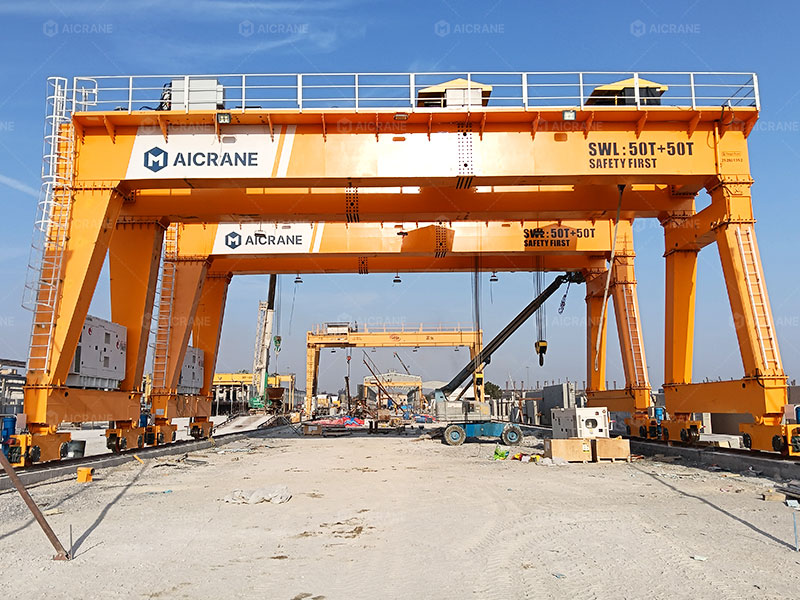
On paper, a 90-ton precast beam is a static value. In physics, however, that value changes the moment the 100 ton gantry crane engages its winches. This is known as the Dynamic Load Factor (DLF).
When the crane begins to lift, the acceleration of the hoist adds kinetic energy to the system. If a hoist moves at a constant speed, the tension in the cables equals the weight of the load (F = mg). But if the operator starts the lift abruptly, the force increases (F = m(g + a)). For a 90-ton load, even a modest acceleration can momentarily push the effective weight over 100 tons, exceeding the crane’s rated capacity and stressing the concrete’s lifting anchors.
The Solution: Modern gantry cranes utilize Variable Frequency Drives (VFDs). These systems ensure a “soft start,” ramping up motor torque gradually to keep the dynamic forces within a 5% to 10% margin of the static weight.
2. Hook Center of Gravity (CoG) and Load Eccentricity
For a 100-ton lift to be stable, the center of gravity of the precast element must be aligned vertically with the center of the hook. If the CoG is offset—often the case with asymmetrical precast components—the load will “shift” as it leaves the ground to find its natural equilibrium.
The Physics of the Shift:
When a load shifts, it creates a pendulum effect. For a double girder gantry crane, this lateral movement is dangerous because the crane’s legs are designed primarily for vertical compression. Horizontal forces (side-loading) can cause the gantry’s bridge to twist or the wheels to bind against the rail.
Optimization: Operators of 100-ton gantries often use dual-trolley systems. By having two independent hoisting points on the same bridge, the operator can adjust the tension in each hook separately, “leveling” an asymmetrical load before it is fully suspended.
3. Load Distribution in the Gantry Structure
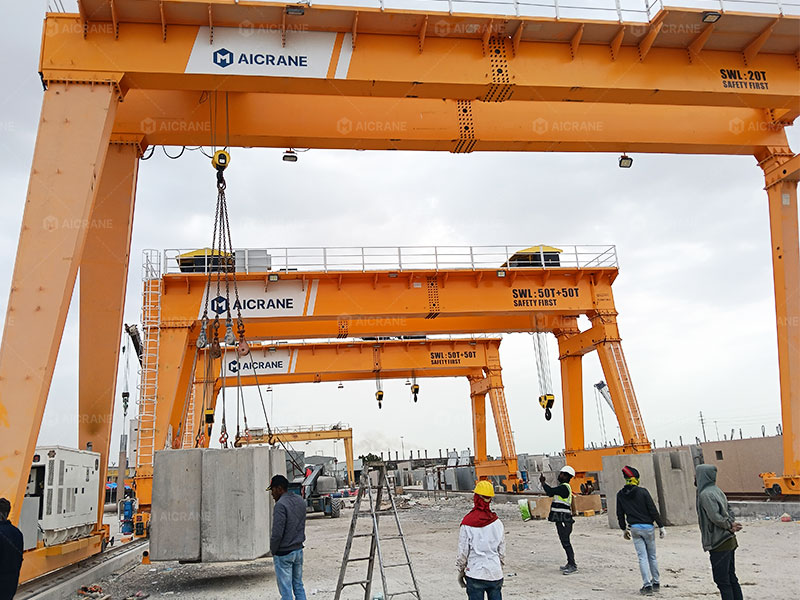
A 100-ton gantry crane is essentially a massive bridge resting on two or four legs. The way the load is distributed across these components changes based on the trolley’s position.
-
Mid-Span Loading: When the trolley is in the center of the bridge, the bending moment on the main girder is at its maximum. The weight is distributed equally (50/50) between the two leg sets.
-
End-Span Loading: As the trolley moves closer to one leg set to discharge a load, the distribution might shift to 90/10.
The physics of wheel loads is critical here. A 100-ton load, plus the 40-ton weight of the heavy duty gantry crane itself, creates massive point loads on the rails. If the load distribution isn’t calculated correctly, the rail or the underlying concrete foundation may suffer from “settlement,” which can cause the crane to derail.
4. Rigging Geometry and Internal Concrete Stress
The 100-ton gantry crane is only the “prime mover.” The actual physics of load distribution happens within the rigging hardware. The most misunderstood concept in precast lifting is the horizontal force component created by sling angles.
When using a standard two-leg sling arrangement, the tension in the slings increases as the angle between them widens.
-
At a 60-degree angle, the tension in each sling is roughly 58% of the load weight.
-
At a 30-degree angle, the tension in each sling equals 100% of the load weight.
More importantly, these angles create a compressive force along the top of the precast element. If you are lifting a 90-ton, 30-meter concrete beam with a shallow sling angle, you are effectively trying to “crush” the beam from both ends. Concrete is strong in compression, but a slender beam can “buckle” under this horizontal force before it ever reaches its destination.
5. The Role of Spreader Beams in 100-Ton Lifts
To manage the physics of large-scale lifting, Spreader Beams are mandatory for ultra-long or fragile precast elements. A spreader beam converts the angled pull of the crane’s slings into a purely vertical pull on the concrete.
By using a spreader beam, the internal stresses in the precast element are simplified. The concrete only “feels” its own weight pulling down against the vertical anchors. This eliminates the risk of “edge spalling” and buckling, ensuring that the structural integrity of the precast unit remains exactly as the engineers intended during the casting phase.
6. Redundancy and Safety Factors (The 5:1 Rule)
In the physics of load distribution, we must account for the “unknowns” – material fatigue, wind gusts, and minor rigging imperfections. This is handled through Safety Factors.
For the 100-ton gantry crane, the structural steel usually has a safety factor of 2:1 or 3:1. However, the rigging hardware (slings, shackles, and anchors) typically follows a 5:1 safety factor. This means a shackle rated for 20 tons is actually designed to break at 100 tons.
Why the difference? Rigging hardware is subject to much higher wear and tear than the crane’s main girder. A single kink in a wire rope or a small nick in a synthetic sling can reduce its capacity by 50% instantly. In a 100-ton lift, there is no room for these variables to result in a failure.
7. Ground Bearing Pressure and Rail Stability
The final destination of all 100 tons of force is the ground. A 100-ton gantry crane operates on a rail system, and the physics of Ground Bearing Pressure (GBP) is a silent deal-breaker.
The force is transmitted from the hook, through the trolley, across the girder, down the legs, and into the wheel bogies. If the rail is supported by a concrete sleeper that is uneven, the load distribution across the wheels becomes uneven. This can lead to “wheel skid” or, worse, a structural crack in the gantry leg due to uneven torsional stress.
Precast yards must ensure that the rail foundation is perfectly leveled and capable of handling the Max Wheel Load, which occurs when the crane is carrying 100 tons and the trolley is positioned at one extreme end of the bridge.
8. Environmental Physics: The Wind Factor
Finally, we must consider the physics of the environment. A large precast element, such as a wall panel or a box girder, has a massive surface area. In high winds, this element acts like a sail.
Wind pressure adds a lateral load to the precast concrete gantry crane that was not part of the original weight calculation. A 20 mph wind can add several tons of lateral force to a 100-ton lift. Modern 100-ton gantries are equipped with anemometers (wind speed sensors) that automatically trigger an alarm or lock the crane’s brakes if wind speeds exceed safe operating limits (typically 12-15 m/s).
Conclusion
The physics of precast lifting with a 100-ton gantry crane is a balance of forces. It requires a deep understanding of how vertical weight translates into horizontal compression, how acceleration creates dynamic spikes, and how the center of gravity dictates the stability of the entire system.
By respecting these physical laws – through the use of spreader beams, VFD-controlled hoists, and rigorous rigging geometry—project managers can ensure that even the most massive precast components are handled with precision. In the world of 100-ton lifts, success isn’t just about moving weight; it’s about managing the invisible forces that hold that weight together.