Lifting large yachts is one of the most demanding operations in the marine industry. Unlike standard boat handling, superyachts and large commercial vessels require extremely high precision, controlled force distribution, and carefully engineered lifting systems. A 200 ton travel lift is commonly used in modern shipyards and marinas to handle this level of workload safely and efficiently.
However, the safe lifting of large yachts is not simply about equipment capacity. It involves advanced operational techniques, structural understanding, load management, environmental awareness, and strict procedural discipline. Even minor errors in slinging, alignment, or movement can lead to serious structural damage or safety risks.
This article explores advanced techniques and best practices for safely lifting large yachts using a 200 ton travel lift, focusing on engineering principles, operational procedures, and real-world safety considerations.
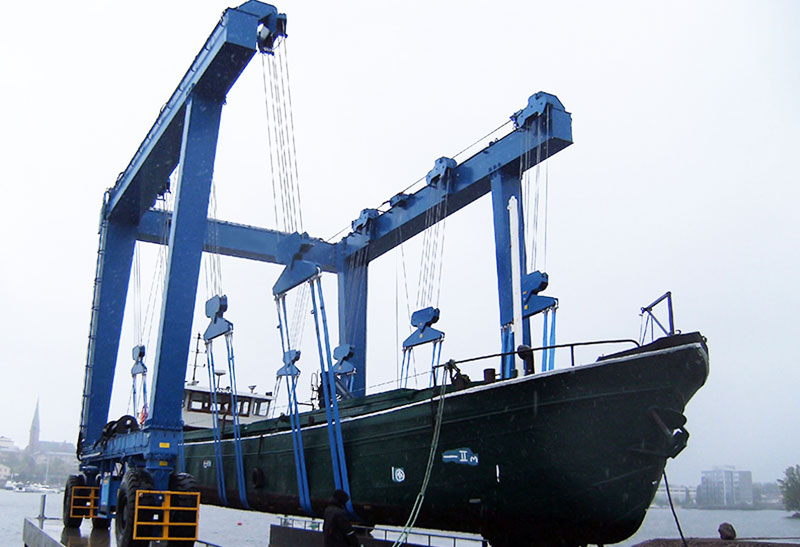
1. Understanding the Complexity of Large Yacht Lifting
Large yachts are not uniform lifting objects. Their structure includes:
- Lightweight composite hull sections
- High-value interior fittings
- Irregular weight distribution
- Sensitive keel and propulsion systems
- Extended beam width and variable draft
Unlike industrial steel loads, yachts are structurally sensitive and deformation-prone. This means lifting forces must be distributed evenly across designated structural points.
A 200 ton travel lift is designed to provide:
- High load capacity for superyachts
- Adjustable sling positioning
- Controlled synchronized lifting
- Mobility for yard transportation
But safe operation depends on how effectively the operator manages these features.
2. Importance of Load Assessment and Weight Verification
Before any lifting operation, accurate weight verification is essential.
Key steps include:
- Reviewing yacht design displacement
- Confirming fuel, water, and equipment load
- Estimating additional onboard cargo or modifications
- Verifying center of gravity (COG)
Incorrect weight estimation can cause:
- Sling overload
- Uneven load distribution
- Structural stress concentration
- Travel lift instability
Modern shipyards often use digital load monitoring systems integrated into travel lifts to ensure real-time weight tracking during lifting.
3. Proper Sling Positioning and Load Distribution
Sling placement is the most critical factor in yacht lifting safety.
For large yachts, slings must:
- Align with reinforced hull sections
- Avoid propeller shafts, rudders, and sensitive appendages
- Be positioned symmetrically
- Maintain equal tension on both sides
Advanced lifting techniques include:
3.1 Multi-Point Load Distribution
Instead of relying on simple four-point lifting, large yachts often require multi-sling systems to distribute load evenly along hull reinforcement zones.
3.2 Adjustable Sling Frames
200 ton travel lifts typically use adjustable beam systems that allow precise sling spacing adjustments based on hull geometry.
3.3 Real-Time Tension Monitoring
Load cells integrated into sling points help detect imbalance during lifting.
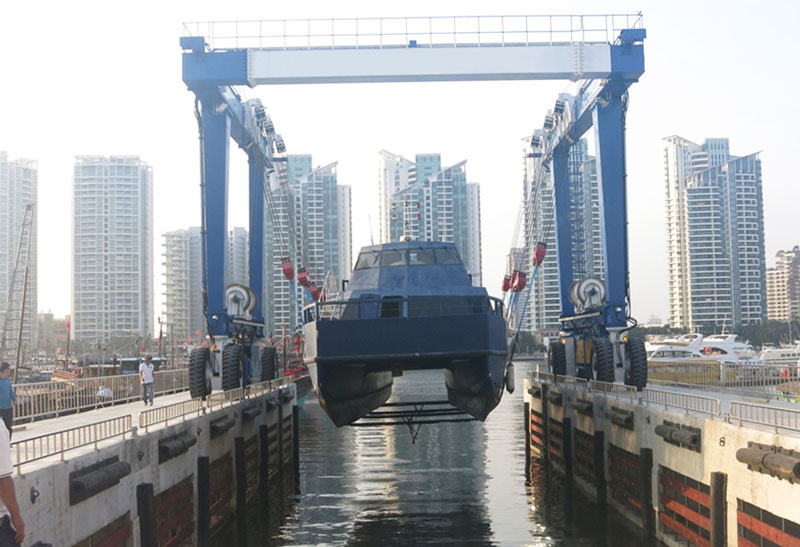
4. Structural Alignment Before Lifting
Proper alignment between the yacht and the large boat hoist is essential before hoisting begins.
Operators must ensure:
- The yacht is centered between lifting towers
- Slings are not twisted or crossed
- Hull is fully supported at designated points
- No lateral force is applied during initial lift
Even a slight misalignment can cause uneven stress distribution, which may lead to hull deformation or instability during lifting.
Laser alignment systems are increasingly used in modern shipyards to improve positioning accuracy before hoisting.
5. Controlled Lifting Procedure for 200 Ton Travel Lifts
The lifting process must follow a gradual, staged approach:
Step 1: Pre-Tensioning
Slings are tightened just enough to take up slack without fully lifting the yacht.
Step 2: Balance Check
Operators inspect:
- Load distribution
- Sling tension symmetry
- Hull response
Step 3: Slow Initial Lift
The yacht is lifted a few centimeters to verify stability.
Step 4: Full Elevation
After confirming balance, the yacht is raised to full transport height at controlled speed.
Step 5: Movement Phase
The travel lift moves slowly along a pre-planned path to the designated yard location.
Each stage must be executed with strict control to avoid sudden load shifts.
6. Role of Hydraulic and Control Systems
Modern 200 ton travel lifts rely heavily on advanced hydraulic and electronic systems.
Key features include:
- Synchronized hydraulic lifting cylinders
- Centralized PLC control systems
- Anti-sway stabilization systems
- Emergency stop functions
- Load monitoring sensors
These systems ensure that all lifting legs operate in perfect synchronization, preventing tilting or uneven load distribution.
Manufacturers such as Aicrane integrate intelligent control systems into their travel lifts to improve operational precision and safety, especially in high-capacity yacht handling environments.
7. Wind and Environmental Safety Considerations
Environmental conditions play a major role in safe yacht lifting operations.
7.1 Wind Load Impact
Large yachts act like aerodynamic structures. Strong wind can:
- Cause lateral sway during lifting
- Increase sling tension imbalance
- Affect travel lift stability during movement
Most shipyards set wind speed limits (commonly 10–15 m/s) for lifting operations.
7.2 Ground Conditions
Travel lifts require stable ground surfaces with:
- High load-bearing capacity
- Even compaction
- Proper drainage
Uneven ground can cause wheel load imbalance, affecting lifting safety.
7.3 Wet or Slippery Conditions
Rain or seawater exposure increases risk during positioning and movement phases.
8. Operator Skill and Coordination
Even with advanced equipment, human operation remains a critical factor.
Operators must be trained in:
- Load calculation interpretation
- Sling adjustment techniques
- Emergency response procedures
- Real-time monitoring system usage
Communication between crane operators, ground crew, and signal personnel must be clear and standardized.
In large yacht operations, a single miscommunication can lead to serious operational risk.
9. Advanced Safety Systems in Modern Travel Lifts
To enhance safety, modern 200 ton travel lifts are equipped with advanced technologies such as:
- Overload protection systems
- Automatic load balancing correction
- Real-time structural stress monitoring
- Anti-collision sensors
- Remote diagnostics systems
These technologies reduce reliance on manual judgment and improve operational consistency.
10. Yacht Protection Measures During Lifting
Since yachts are high-value assets, additional protective measures are required:
- Protective pads on sling contact points
- Non-marking sling materials
- Hull reinforcement checks before lifting
- Controlled pressure distribution systems
Any contact pressure must be carefully controlled to avoid gelcoat or structural damage.
11. Emergency Procedures and Risk Management
Despite precautions, shipyards must always be prepared for emergencies.
Common emergency protocols include:
- Immediate load lowering in case of imbalance
- Hydraulic system shutdown procedures
- Wind condition evacuation thresholds
- Sling failure contingency planning
Regular safety drills ensure that operators respond quickly under abnormal conditions.
12. Preventive Maintenance for Travel Lifts
A 200 ton travel lift must be maintained regularly to ensure safe yacht lifting operations:
- Hydraulic system inspection
- Wire rope or sling condition checks
- Wheel and axle alignment verification
- Sensor calibration
- Structural weld inspection
Preventive maintenance reduces the risk of unexpected failure during lifting operations.
Conclusion
Safely lifting large yachts using a 200 ton travel lift requires far more than high-capacity equipment. It is a combination of engineering precision, advanced control systems, environmental awareness, and highly trained operators.
Key success factors include:
- Accurate weight and COG analysis
- Proper sling positioning and load distribution
- Controlled multi-stage lifting process
- Advanced hydraulic synchronization systems
- Strict environmental and wind monitoring
- Continuous safety training and maintenance
When these elements are properly integrated, shipyards can achieve safe, efficient, and damage-free yacht handling operations, even for the most complex and high-value vessels in the marine industry.