Heavy-duty gantry cranes are critical assets in industries such as steel manufacturing, ports, shipyards, precast concrete plants, and large-scale warehouses. Their ability to lift and transport extremely heavy loads with precision makes them indispensable. However, the efficiency and safety of these cranes are not only determined by the crane structure itself but also by the foundation on which they operate. A well-designed rail foundation ensures stability, smooth operation, and extended service life for both the crane and the supporting infrastructure. This article delves into the principles, considerations, and best practices for rail foundation design for heavy-duty gantry cranes.
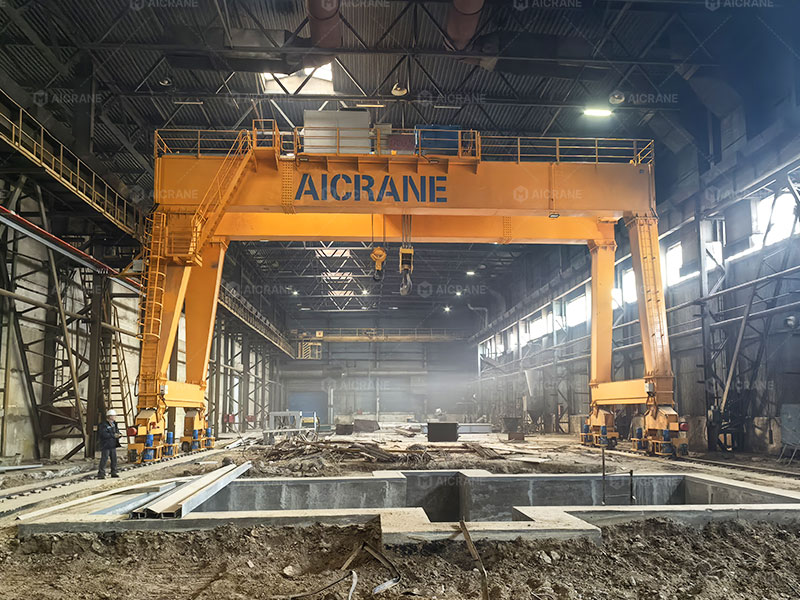
1. Understanding the Role of Rail Foundations
The rail foundation serves as the critical interface between the gantry crane and the ground. Heavy duty gantry cranes, particularly those with lifting capacities exceeding 50 tons, exert significant static and dynamic loads on their rails. These loads include:
-
Vertical loads from the crane structure and lifted materials.
-
Horizontal forces from acceleration, deceleration, and braking.
-
Torsional forces due to uneven loading or off-center lifting.
-
Impact loads from crane travel or abrupt trolley movement.
An inadequately designed foundation can lead to rail misalignment, crane vibration, uneven wear of wheels and rails, structural damage to the crane, and, in extreme cases, operational hazards. Therefore, the foundation must distribute loads evenly, resist deformation, and accommodate operational tolerances.
2. Key Design Considerations
a) Load Analysis
Before designing a rail foundation, engineers must perform a detailed load analysis. This includes:
-
Dead Load: The weight of the rail gantry crane itself, including the bridge, trolley, hoist, and end trucks.
-
Live Load: The maximum rated load of the crane during operation.
-
Dynamic Effects: Additional forces generated during acceleration, braking, and trolley movement. These can be 10–25% higher than static loads, depending on crane speed and duty class.
-
Impact Factor: Sudden load impacts, such as starting or stopping the crane under full load, which amplify the stresses on the foundation.
The load analysis determines the required bearing capacity of the soil and the foundation’s dimensions.
b) Soil and Subgrade Conditions
The performance of a rail foundation is heavily influenced by the underlying soil. Conducting a geotechnical survey is essential to determine:
-
Soil type and bearing capacity
-
Settlement potential
-
Groundwater conditions
-
Frost susceptibility
Soft or expansive soils may require deep foundations, such as piles or reinforced concrete footings, to prevent settlement or shifting. In contrast, firm and well-compacted soils may allow for shallower foundations, provided they meet load-bearing criteria.
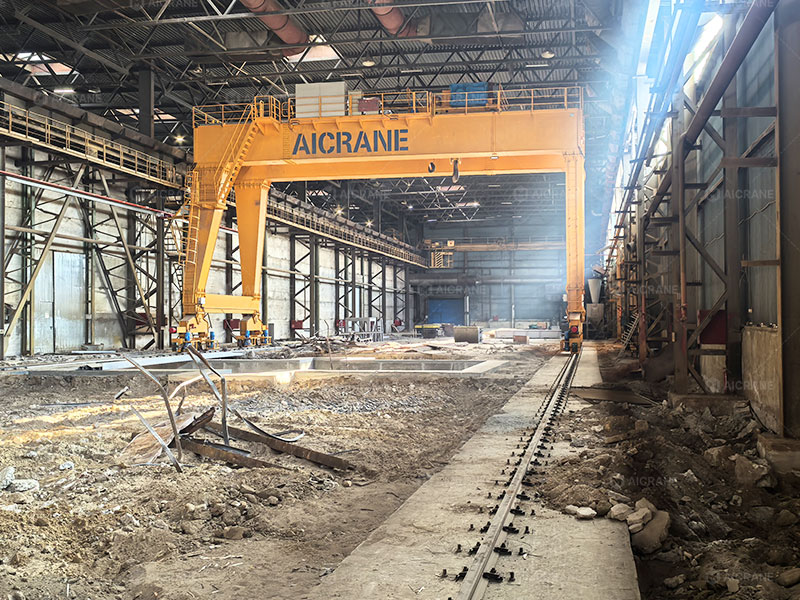
c) Rail Alignment and Tolerances
Rail alignment is critical for smooth crane operation. Misaligned rails can cause excessive wear on wheels, structural stress on the crane frame, and operational vibration. Important parameters include:
-
Gauge Width: The distance between rails must meet precise specifications, often within ±3 mm for heavy-duty applications.
-
Leveling and Elevation: Rails must be level along their length and have consistent elevation between both sides of the crane runway.
-
Straightness: Horizontal and vertical deviations must be minimized to prevent crane sway and wheel derailment.
The foundation must support these tolerances over time, even under cyclic loading and environmental changes.
d) Foundation Type
The type of foundation chosen depends on the gantry crane specifications, soil conditions, and project budget. Common types include:
-
Concrete Slab Foundations
-
Suitable for light to medium-duty cranes on firm soils.
-
Provides a continuous base that distributes loads evenly.
-
Requires proper reinforcement to prevent cracking due to heavy loads.
-
-
Reinforced Concrete Footings
-
Common for heavy-duty cranes.
-
Consist of individual footings under each rail or wheel.
-
Can be combined with grade beams to increase stiffness.
-
Footing depth is determined by soil bearing capacity and frost depth.
-
-
Pile-Supported Foundations
-
Necessary for weak soils or areas with high groundwater.
-
Load is transferred to deeper, more stable soil strata.
-
Often used in ports, shipyards, and industrial sites where heavy industrial gantry cranes operate over long spans.
-
-
Hybrid Foundations
-
Combination of reinforced concrete footings and grade beams.
-
Offers enhanced stiffness and load distribution.
-
Can accommodate cranes with high dynamic loads and large spans.
-
e) Reinforcement and Structural Design
Heavy-duty cranes generate concentrated forces at wheel locations, requiring robust foundation reinforcement. Key considerations include:
-
Rebar Layout: Longitudinal and transverse reinforcement to resist bending and shear.
-
Load Distribution: Grade beams or tie beams connecting footings reduce differential settlement.
-
Crack Control: Reinforcement designed to limit crack width under repeated loading.
-
Durability: Adequate concrete cover to protect against corrosion, especially in outdoor or marine environments.
f) Drainage and Environmental Protection
Water accumulation around crane rails can compromise foundation integrity. Proper drainage systems, including sloped surfaces, drainage channels, and waterproofing measures, are necessary to:
-
Prevent soil erosion
-
Reduce frost heave
-
Protect reinforced concrete from water-induced deterioration
Environmental considerations, such as freeze-thaw cycles, chemical exposure, and heavy rainfall, must be integrated into foundation design.
3. Installation and Construction Practices
A well-designed foundation alone is insufficient if construction practices are poor. Critical steps include:
-
Site Preparation: Excavate to the required depth and compact soil to reduce settlement.
-
Formwork and Alignment: Use precision leveling instruments to ensure proper alignment of footings and rails.
-
Concrete Pouring and Curing: Pour concrete in stages to avoid cold joints and allow proper curing for strength.
-
Rail Fixing: Rails are usually embedded in concrete or fixed on tie plates, with adjustable shims to maintain alignment.
-
Post-Installation Testing: Verify rail gauge, level, and straightness before crane operation.
Regular inspection during construction helps prevent long-term operational issues.
4. Maintenance and Monitoring
Even with excellent design and construction, rail foundations require ongoing maintenance:
-
Rail Alignment Checks: Periodically measure gauge and level to detect settlement or misalignment.
-
Concrete Condition: Inspect for cracks, spalling, or erosion.
-
Wheel and Rail Wear: Monitor wear patterns, which can indicate foundation deflection or soft spots.
-
Load Monitoring: Ensure crane operations do not exceed rated loads, which can compromise the foundation.
Incorporating sensors or automated monitoring systems can provide real-time feedback on foundation performance, helping prevent costly downtime or repairs.
5. Safety and Operational Implications
The rail foundation directly impacts safety and operational efficiency. A poorly designed foundation can lead to:
-
Crane derailment or tipping
-
Excessive vibration and reduced load handling precision
-
Accelerated wear of crane components
-
Increased maintenance costs and operational interruptions
Conversely, a robust foundation enhances:
-
Smooth and stable crane movement
-
Precise load positioning
-
Extended service life of the crane and rail system
-
Overall workplace safety and efficiency
Conclusion
Rail foundation design is a cornerstone of heavy-duty gantry crane operation. By carefully considering load analysis, soil conditions, alignment tolerances, foundation type, reinforcement, drainage, and maintenance, engineers can create foundations that ensure safe, reliable, and efficient crane performance. Heavy-duty cranes operate in demanding environments and are expected to lift massive loads repeatedly; thus, their foundation must be designed with precision and foresight. Investing in a well-engineered rail foundation not only protects the crane and cargo but also maximizes operational efficiency, safety, and return on investment for industrial operations.
For industries relying on heavy-duty gantry cranes, attention to rail foundation design is not optional—it is fundamental.