For contractors evaluating a new concrete production business, the mobile concrete plant price is only one part of the investment decision. The more important question is whether the equipment can generate enough production value, reduce logistics costs, and remain productive across multiple projects. In Latin America, where construction sites can be widely distributed and infrastructure projects often require concrete close to the point of use, mobility can have a direct impact on profitability.
Unlike a conventional stationary facility, a mobile concrete batching plant can be transported between projects and installed with less site preparation. This flexibility makes it particularly attractive to road contractors, mining companies, commercial builders, and companies handling short- or medium-term projects. When evaluating the mobile concrete plant price(planta de concreto móvil precio), however, buyers should look beyond the initial equipment cost and consider production capacity, utilization rate, local concrete demand, transportation costs, and project duration, all of which can have a direct impact on overall profitability.
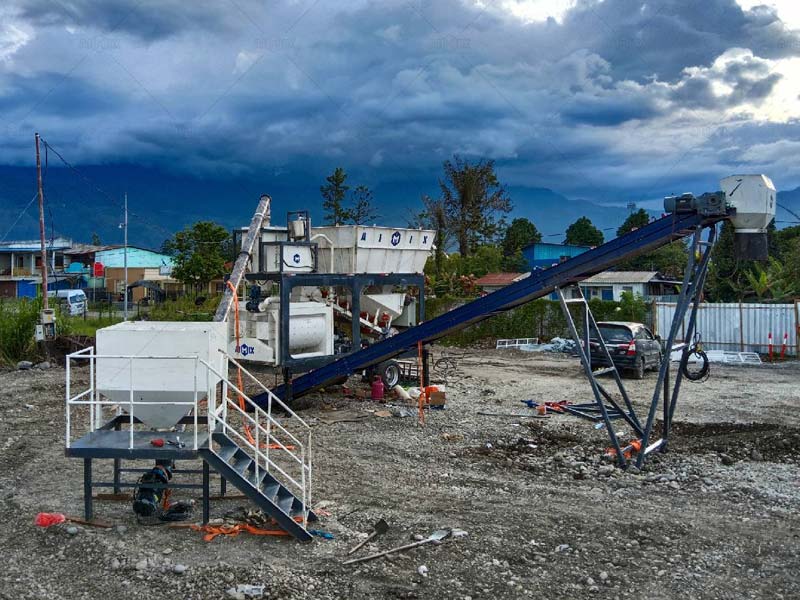
Why Mobile Concrete Plants Can Be Profitable in Latin America
Latin American construction projects are often geographically diverse. A contractor may complete a highway section in one area and then move to another location for a bridge, residential development, or industrial project. Transporting ready-mixed concrete over long distances can increase costs and create scheduling challenges.
Concrete Production Closer to the Jobsite
A mobile concrete plant allows contractors to produce concrete closer to where it is needed. Shorter delivery distances can reduce dependence on external ready-mix suppliers and help contractors maintain greater control over their concrete supply.
This advantage becomes more significant when projects require large quantities of concrete over an extended period. Instead of repeatedly purchasing concrete from a distant commercial supplier, contractors can establish production capacity closer to the construction site.
Better Equipment Utilization Across Projects
Equipment utilization is one of the most important factors affecting the profitability of a mobile concrete plant. A stationary plant may remain at one location after a project ends, while a mobile system can potentially move to another construction site.
For contractors with multiple projects, the same concrete mixing plant can therefore generate revenue across several contracts. Higher annual utilization can help distribute the initial equipment investment over more cubic meters of concrete production.
How to Evaluate the Mobile Concrete Plant Price
Comparing the mobile concrete plant price requires more than looking at the equipment quotation. Contractors should calculate the complete project investment, including transportation, installation, commissioning, aggregate handling, cement storage, power supply, labor, maintenance, and potential relocation costs.
| Investment Factor | Impact on Profitability |
|---|---|
| Mobile concrete plant price | Determines initial capital requirements |
| Production capacity | Affects potential concrete output and revenue |
| Transportation costs | Influence the cost of supplying concrete |
| Installation time | Determines how quickly production can begin |
| Utilization rate | Strongly affects investment recovery |
| Maintenance costs | Influence long-term operating expenses |
A plant with a lower purchase price is not automatically the most profitable option. If its capacity is insufficient for the project or its configuration creates high operating costs, the apparent initial saving may disappear over time.
When a Mini Concrete Plant Makes More Sense
Not every contractor needs a high-capacity production system. For small housing projects, local road works, rural construction, and limited-volume commercial projects, a mini concrete plant(mini planta de concreto) may provide a better balance between investment and actual demand.
Matching Capacity With Concrete Demand
The key is to match plant capacity with realistic project requirements. Purchasing a large concrete batching plant when average demand is relatively low can result in underutilized equipment and a longer investment recovery period.
A mini concrete plant can be particularly useful when the contractor needs independent concrete production but does not have enough demand to justify a larger system. Its compact configuration can also simplify transportation and site organization.
When to Choose a Larger Mobile System
For highway construction, bridges, mining infrastructure, and major commercial projects, demand can be significantly higher. In these situations, a larger mobile concrete batching plant may provide better economics because its production capacity can keep pace with continuous concrete consumption.
The decision between a mini concrete plant and a larger mobile system should therefore be based on actual hourly demand, total project volume, project duration, and the possibility of using the equipment on future contracts.
What About a Concrete Batching Plant Peru Project?
Peru provides an important example of how site conditions can influence mobile concrete equipment selection. Infrastructure construction, mining development, road improvement, and urban expansion can create demand for concrete production in locations where transporting ready-mixed concrete from an established plant is not always efficient.
For a concrete batching plant Peru project, contractors should evaluate transportation distances, terrain, aggregate availability, access roads, altitude, local regulations, and expected concrete consumption before choosing equipment.
Why Mobility Can Matter in Peru
When a project is located far from major urban centers, establishing a mobile concrete production facility closer to the construction site can reduce reliance on external concrete suppliers. This can provide greater control over production schedules and help maintain a consistent supply for critical construction activities.
The same principle applies to other Latin American markets. A concrete batching plant Peru(planta dosificadora de concreto Perú) application may have different operating conditions from projects in Bolivia, Ecuador, Mexico, Chile, or Colombia, but the fundamental investment analysis remains similar.
Key Factors That Determine Profitability
Buying a mobile concrete plant can be profitable when the equipment is correctly matched to project demand and used efficiently. Contractors should evaluate several factors before making a purchase.
- Concrete demand: Estimate the project’s average and peak hourly requirements.
- Project duration: Longer projects generally provide more opportunities to utilize the equipment.
- Future projects: Consider whether the plant can be relocated and reused after the current contract.
- Material availability: Check local sources and transportation costs for aggregates, cement, and water.
- Labor requirements: Evaluate operator availability and training requirements.
- Maintenance support: Ensure spare parts and technical assistance are accessible.
- Logistics: Calculate the cost and time required to move the plant between projects.
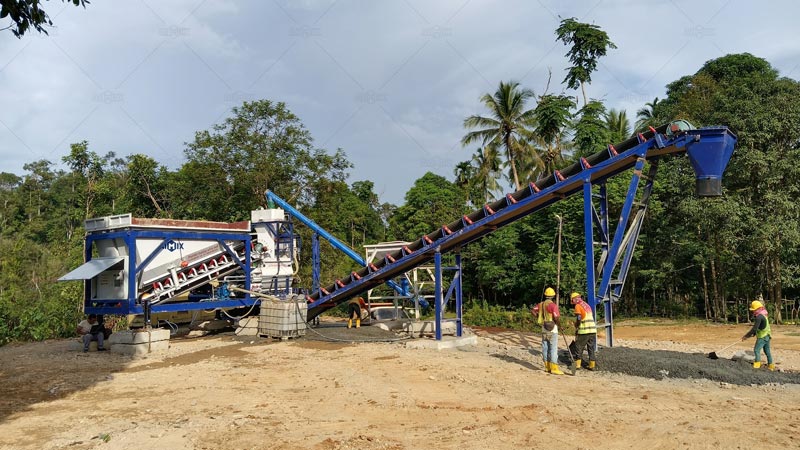
Mobile or Stationary Concrete Mixing Plant
The choice between a mobile and stationary concrete mixing plant(planta concretera) depends largely on how the equipment will be used. A stationary plant can be advantageous when a contractor operates a long-term commercial concrete business from a fixed location. A mobile plant is generally more attractive when projects are temporary, geographically dispersed, or frequently relocated.
Contractors should also consider whether they will sell concrete commercially or primarily produce concrete for their own construction projects. Captive production for large infrastructure projects can generate value by reducing dependence on third-party suppliers, while commercial operations require a broader assessment of local market demand and customer volume.
Calculating the Potential Return on Investment
A practical profitability calculation should compare total investment and operating expenses with the value generated from concrete production. Contractors can estimate the required production volume using expected concrete demand, operating days, selling or internal transfer value per cubic meter, and total production costs.
For example, a contractor operating a mobile concrete plant across several road projects may achieve better equipment utilization than a contractor using the same machine for only a few months. Relocation capability can therefore influence the annual return just as much as the initial mobile concrete plant price.
Ultimately, buying a mobile concrete plant can be a profitable investment in Latin America when project demand, plant capacity, mobility, and operating costs are carefully matched. Whether the right solution is a mini concrete plant for smaller contracts or a higher-capacity concrete mixing plant for major infrastructure work, contractors should evaluate the equipment based on its total lifecycle value rather than purchase price alone. For markets such as Peru, a well-planned concrete batching plant Peru project can benefit particularly from producing concrete closer to demanding and remote construction sites.